

Pickleball rules for beginners
The few rules a newcomer needs before the first game, each with the rule number it comes from in the 2026 USA Pickleball rulebook.
What are the basic rules of pickleball?
Serve diagonally past the kitchen, swinging upward below the waist or after a bounce. Serve and return must bounce. Never volley while touching the kitchen. Lines are in, except the kitchen line on a serve. Only the serving side scores in standard scoring; the rulebook’s introduction says games typically go to 11, won by 2.
The basic rules, one by one
PickleCrew chose these ten for newcomers. The rulebook has no list of basic rules.
- Serve with an upward swing, the ball no higher than your waist and the paddle head no higher than your wrist, or hit a dropped ball after it bounces. (Rules 7.C.1, 7.C.2, 7.C.3 and 7.D)
- When you serve, keep at least one foot on the ground behind the baseline, with neither foot on the court or the baseline, inside the sideline and centerline extended. (Rules 7.A.1, 7.A.2 and 7.A.3)
- Serve to the service court diagonally opposite. The ball must clear the kitchen and land in that court; touching the net on the way is allowed. (Rule 7.E)
- Let the serve bounce before you return it, and the serving side must let the return bounce too. After those two bounces, volleys are allowed outside the kitchen. (Rules 10.A and 11.A)
- Return the ball before it bounces a second time. (Rule 10.B)
- Don’t volley while touching the kitchen or its lines. You may stand in it at any other time. (Rules 3.A.4.c, 11.A and 11.A.1)
- A ball that lands on a line is in, with one exception: a serve that lands on the kitchen line is out. (Definitions and Rules 3.A.4.c, 3.A.4.f, 8.B and 8.C)
- In standard scoring you win a point only when you or your team is serving. (Rule 4.A)
- It’s a fault against you if your shot lands out or fails to cross the net, or if the ball touches you, except your paddle or the hand holding it. (Rules 10.C.1, 10.C.2 and 10.C.3)
- Call the lines on your own end. Call a ball out only when you clearly see space between it and the line; if in doubt, it’s in. (Rules 8.A, 8.D and 8.E)
The court
The court is 20 feet wide and 44 feet long for singles and doubles. The net is 36 inches high at the sidelines and 34 inches at the center. (Rules 3.A.1, 3.B.6 and 3.B.7)
The non-volley zone reaches 7 feet from the net on each side. Its lines are part of it, and it covers only the ground, not the air above it. (Rule 3.A.4.c)
Each service court includes its baseline, sideline and centerline. You serve from the serving area behind the baseline, between the sideline and centerline extended. (Rules 3.A.4.f and 3.A.4.g)
The rules on one page
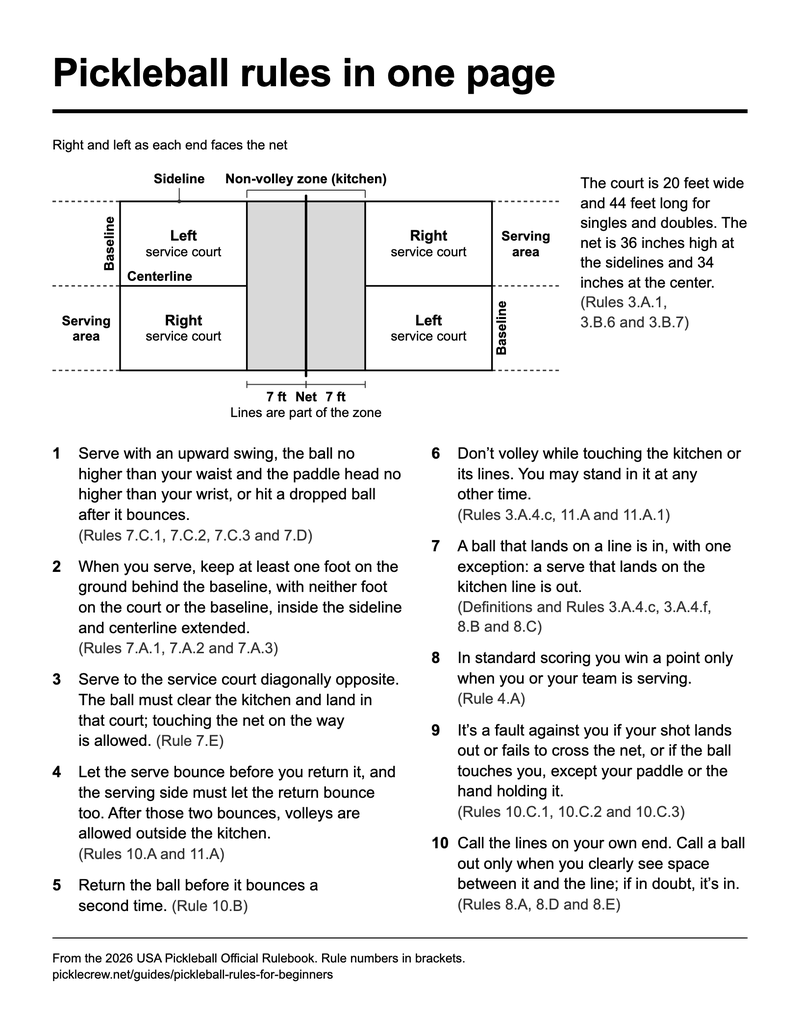
Free to print. One page, US Letter or A4, black and white.
The ten rules above with their rule numbers, and the court drawn and labelled. Pin it by the courts or hand it out at a first session.
Serving
The rulebook never uses the word “underhand”. It describes two serves, and you may use either.
- A volley serve is hit before the ball bounces, with the paddle moving in an upward arc, its head no higher than the wrist and the ball no higher than the waist. (Definitions and Rules 7.C.1, 7.C.2 and 7.C.3)
- A drop serve is hit after the ball bounces. Drop it from a natural height without throwing or pushing it; it may bounce any number of times, anywhere, before you hit it. (Rules 7.D, 7.D.1, 7.D.2, 7.D.3 and 7.D.4)
- Spin is allowed when the paddle hits the ball, but you may not add spin as you release it. If you do, the receiver may call for a replay before returning the serve. (Rules 7.B.2 and 7.B.2.a)
- The receiver must be able to see you release the ball. If they can’t, they may call for a replay before the return. (Rules 7.B.3 and 7.B.3.a)
Who serves, from which side and when the serve passes are scoring rules: see the pickleball scoring guide.
The two-bounce rule
- The rulebook names the two-bounce rule and the non-volley zone as two of pickleball’s unique features. (Section 1)
- The serve must bounce before it is returned, and the return must bounce before the serving side hits it. (Rule 10.A)
- If the receiver hits the serve before it bounces, it’s a fault against the receiver. If the server or partner hits the return before it bounces, it’s a fault against the serving side. (Rules 10.A.1 and 10.A.2)
- After those two bounces, players may volley, as long as they start the volley outside the kitchen. (Rules 10.A and 11.A)
The kitchen (non-volley zone)
“Kitchen” is the name players use. The rulebook never uses it.
- The rulebook calls it the non-volley zone: the 7 by 20 foot area on each side of the net where players may not volley. (Definitions and Rule 3.A.4.c)
- A volley is any hit before the ball bounces. (Definitions)
- Every volley must start outside the zone. You may stand in the zone at any time except while volleying. (Rule 11.A)
- If you, or anything touching you, including your partner, touches the zone while you volley, it’s a fault against you. (Rule 11.A.1)
- If your volley’s momentum carries you into the zone, or into anything touching it, it’s a fault, even after the ball is dead. (Definitions and Rule 11.A.2)
- After you’ve touched the zone, both feet must be back on the ground outside it before you volley. (Rule 11.A.3)
In or out
- A return that lands anywhere on the opponents’ end, lines included, is in. A serve must land in the correct service court, whose lines count as part of it. (Definitions and Rules 3.A.4.f and 8.B)
- The kitchen line belongs to the kitchen, so a serve that lands on it is out. (Rules 3.A.4.c and 8.C)
- Each side calls the lines on its own end, and in doubles either partner may call. (Rule 8.A)
- Give the opponent the benefit of the doubt: call a ball out only when you clearly see space between it and the line. A ball you can’t promptly call out is in. (Rules 8.D and 8.E)
- In doubles, if partners disagree on a line call, the ball is in. (Rule 8.H)
- Before the next serve you may ask the opponents to make a call on your end. If they call it clearly, their call stands. (Rule 8.I)
- Spectators are never asked about a call. (Rule 8.J)
Faults
A fault ends the rally against the player or side that commits it. These are the ones newcomers meet first.
- A fault is a rules violation that ends the rally, and the side that commits it loses the rally. (Definitions)
- Hitting a ball that lands out, or that fails to cross the net and lands on your side, is a fault against you. A ball that touches the net stays in play. (Rules 10.C.1, 10.C.2 and 13.A)
- After the serve, if the ball touches you or anything you wear or carry, except your paddle or the hand holding it, it’s a fault against you. (Rule 10.C.3)
- If your shot hits a permanent object, such as a fence or a light, before it bounces on the court, it’s a fault against you. (Definitions and Rule 10.C.4)
- Hitting the ball twice is a fault unless it is one continuous stroke in one direction. (Rule 10.D.1)
- Catching or carrying the ball on your paddle during a rally is a fault. (Rule 12.C)
- On an opponent you may call only kitchen faults and service foot faults. Any other fault you think they made, you may mention after the rally, but the call is theirs. (Rules 9.B.3 and 9.B.4)
- Line calls are separate: you still call the lines on your own end. A service foot fault is a server’s foot in the wrong place under the serving rules above. (Rules 7.A.1, 7.A.2, 7.A.3 and 8.A)
- If the two sides disagree about a fault call, the rally is replayed. (Rule 9.B.3.b)
Scoring in brief
These lines are from the pickleball scoring guide. The three-number call is for doubles.
- Before each serve the score is called as three numbers: the serving team’s score, the receiving team’s score, then the server number, 1 or 2. (Rule 6.B.2)
- The rulebook’s introduction says that typically the first player or team to reach 11 points with a lead of at least 2 wins the game. (Section 1)
- The rules for all play say only that the first player or team to score the winning point wins. They set no points target and no winning margin. (Rule 4.B)
The whole system, with a doubles game worked rally by rally and a score sheet, is in the pickleball scoring guide.
Singles: one on one
- The score is called as two numbers: the server’s score, then the receiver’s. A game starts at “0–0”. (Rule 6.B.1)
- The server serves from the right when their own score is even, zero included, and from the left when it is odd. The receiver stands diagonally opposite. (Rule 5.A.1)
- The server keeps serving, switching sides after every point won, until they lose a rally. (Rule 5.A.2)
- One lost rally by the server is a side out, and the serve passes to the opponent. (Rule 5.A.3)
- Singles uses the same 20 by 44 foot court. The serve, bounce, kitchen, line and fault rules above apply to singles too; who serves from where and the score call change. (Section 1 and Rule 3.A.1)
The lines above about partners are for doubles only. For a whole game of singles see pickleball with 2 players, and for half-court singles see skinny singles.
Courtesy the rulebook asks for
- The rulebook says pickleball needs cooperation and courtesy, and that the opponent gets the benefit of any doubt. (Section 1)
- Make calls promptly, and treat every point the same: the first point counts as much as match point. (Section 1)
- Don’t question or comment on an opponent’s call except by appealing to a referee. (Section 1)
The manners that go with these rules, and a court sign to print, are in the pickleball etiquette guide.
Where these rules come from
Every rule line on this page comes from the 2026 USA Pickleball Official Rulebook, read on November 19, 2026, and ends with the rule it comes from. The wording is ours.
After the rules
To find your level once you’ve played a few games, see pickleball skill levels.
Running a session for newcomers? The open play guide covers rotation and waiting, and the page for organizers gathers the rest.
Frequently asked questions
Can you stand in the kitchen in pickleball?
Yes. You may stand in the kitchen, the non-volley zone, at any time except while volleying. Every volley must start outside it, and both feet must be back outside before your next volley (rules 11.A and 11.A.3).
How many bounces are allowed in pickleball?
Only one on each side: a ball must be returned before its second bounce (rule 10.B). The serve and the return must each bounce once before they are hit (rule 10.A). After that, a ball may be volleyed from outside the kitchen (rule 11.A).
What is a drop serve in pickleball?
A serve hit after the ball bounces. Drop the ball from a natural height without throwing it; it may bounce any number of times, anywhere, before you hit it (rules 7.D.1, 7.D.2, 7.D.3 and 7.D.4). The volley serve’s arc, wrist and waist rules don’t apply to it.
Can you slice serve in pickleball?
“Slice” is a player’s word, not the rulebook’s. Spin from the paddle at contact is allowed; adding spin as you release the ball is not, and the receiver may then call for a replay (rule 7.B.2). A volley serve must still meet the arc, wrist and waist rules (rules 7.C.1, 7.C.2 and 7.C.3).
Can you play pickleball one on one?
Yes. The rulebook says pickleball can be played as singles or doubles, on the same 20 by 44 foot court (Section 1 and rule 3.A.1). In singles, who serves from where and the score call change (rules 5.A.1 and 6.B.1).