

Challenge court
Winners stay on and the next pair in line plays them. What six venues set, how to set one up, and a sign to fill in.
What is a pickleball challenge court?
A challenge court is a court where the winning pair stays on and the next pair in line plays them. It is a house rule set by the venue or group, not a USA Pickleball rule. All 6 venue rule sheets we read limit how long winners stay.
What venues set
| What the sheet sets | Sheets (of 6) | What they set |
|---|---|---|
| How long winners can stay | 6 | 2 consecutive wins; 2 games in a row; 3 consecutive games; two games; five straight wins; three games. Each in the sheet’s own words. |
| The waiting line | 6 | Paddles in a rack, a saddle or a line: 4. Two paddles hung on the court’s fence: 1. Names on a whiteboard: 1. |
| Winners stay together, stated | 1 | The winning pair stays on together. |
| Winners stay together, implied, not stated | 2 | The wording assumes the same pair stays; neither sheet says so. |
| Players on court may agree to split | 1 | The winners split up and each partners a challenger. |
| Together or split, not stated | 2 | The sheet does not say. |
| A score | 4 | To 11, win by 2: 3 (one also ends games at 15). To 8, win by 1: 1. |
| Who serves first | 0 | None of the sheets says. |
| How many challenge courts | 6 | One named court: 4. An upper and a lower court: 1. Any reserved court not in use: 1. |
| A rating floor on a challenge court | 3 | One of these is a separate up-and-down ladder court. |
| When it goes back to open play | 3 | Too few teams waiting, bad weather, or whenever the club decides. |
How long winners can stay
Sheets (of 6): 6
What they set: 2 consecutive wins; 2 games in a row; 3 consecutive games; two games; five straight wins; three games. Each in the sheet’s own words.
The waiting line
Sheets (of 6): 6
What they set: Paddles in a rack, a saddle or a line: 4. Two paddles hung on the court’s fence: 1. Names on a whiteboard: 1.
Winners stay together, stated
Sheets (of 6): 1
What they set: The winning pair stays on together.
Winners stay together, implied, not stated
Sheets (of 6): 2
What they set: The wording assumes the same pair stays; neither sheet says so.
Players on court may agree to split
Sheets (of 6): 1
What they set: The winners split up and each partners a challenger.
Together or split, not stated
Sheets (of 6): 2
What they set: The sheet does not say.
A score
Sheets (of 6): 4
What they set: To 11, win by 2: 3 (one also ends games at 15). To 8, win by 1: 1.
Who serves first
Sheets (of 6): 0
What they set: None of the sheets says.
How many challenge courts
Sheets (of 6): 6
What they set: One named court: 4. An upper and a lower court: 1. Any reserved court not in use: 1.
A rating floor on a challenge court
Sheets (of 6): 3
What they set: One of these is a separate up-and-down ladder court.
When it goes back to open play
Sheets (of 6): 3
What they set: Too few teams waiting, bad weather, or whenever the club decides.
Read on November 14, 2026: a township’s posted sign in Michigan, a park district’s posted sign in California, a pickleball center’s rules page in Florida, a club’s rules page in Oregon, a club’s code of conduct in California and a club’s program page in North Carolina. Each count is out of those 6.
Setting one up
Every step is your venue’s or your group’s choice. The counts say what the six sheets chose.
- Pick the court (your choice). 4 of the 6 sheets name one court for it, and the other courts keep their own rotation.
- Choose the line (your choice). Paddles in a rack or along the fence, or names on a whiteboard. 5 of the 6 sheets use paddles.
- Together or split (your choice). 1 sheet states that the winners stay together. 1 lets the players on court agree to split, so each winner partners a challenger.
- How long winners stay (your choice). Every sheet sets a limit, from two games to five straight wins. A limit stops one pair holding the court all session.
- The score (your choice). 3 of the 6 play to 11, win by 2. One plays to 8, win by 1. Two don’t say.
- Who serves first (your choice). None of the six sheets says. An explainer we read suggests the challengers serve, or a paddle toss when the winners split.
- Post it. Fill in the sign below and put it where the line forms.
The printable sign
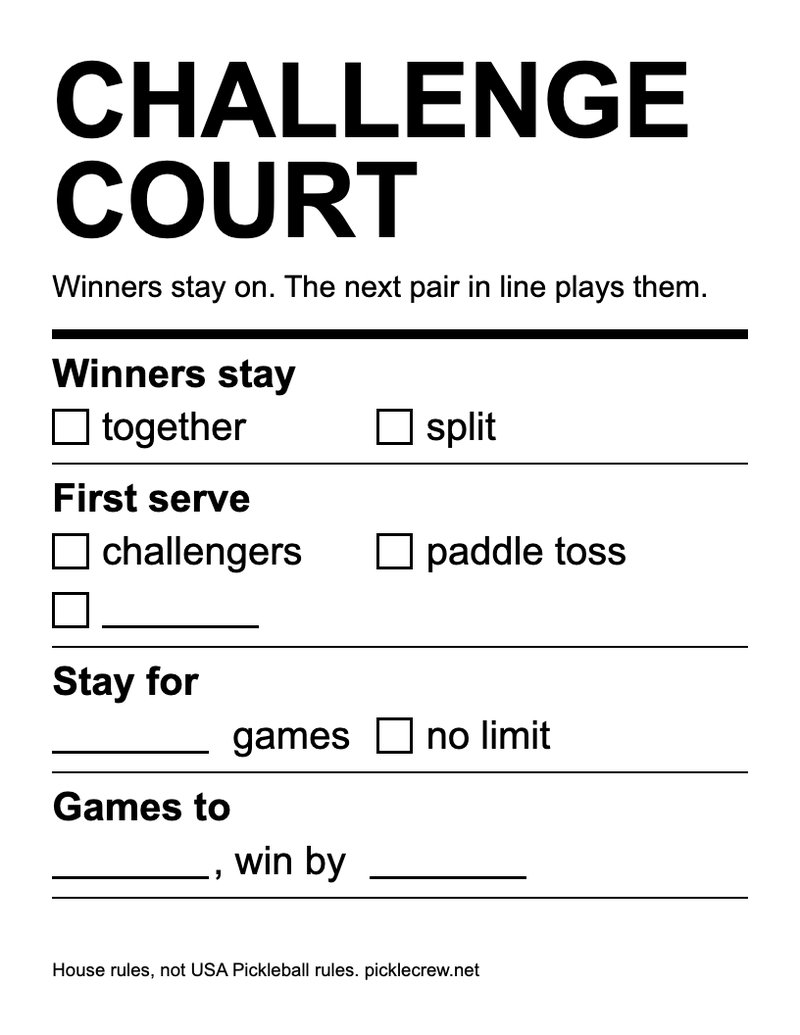
Free to print. One page, set for US Letter and for A4, in black and white.
Blanks and boxes stand where the numbers go, so the sign says what your court chose, with a marker.
Challenge court, open play and king of the court
| Challenge court | Open play (paddle stack) | King of the court | |
|---|---|---|---|
| Who stays on | The winning pair, up to the venue’s limit | Nobody keeps a court | Winners on the king court stay, losers on the bottom court stay |
| Who moves | The losing pair, to the back of the line | All four, to the back of the line | The winners move up one court and the losers move down one. Partners split |
| Courts | One named court at 4 of the 6 venues we read | For many more players than courts | Courts are ranked from the king court down. To have anywhere to climb you need two courts in play |
Who stays on
Challenge court: The winning pair, up to the venue’s limit
Open play (paddle stack): Nobody keeps a court
King of the court: Winners on the king court stay, losers on the bottom court stay
Who moves
Challenge court: The losing pair, to the back of the line
Open play (paddle stack): All four, to the back of the line
King of the court: The winners move up one court and the losers move down one. Partners split
Courts
Challenge court: One named court at 4 of the 6 venues we read
Open play (paddle stack): For many more players than courts
King of the court: Courts are ranked from the king court down. To have anywhere to climb you need two courts in play
The open play and king of the court cells are those guides’ own lines.
Paddle stacking: the waiting line
Paddle stacking is one way to keep the waiting line. Each player puts a paddle in a rack, on a bench or along the fence, and the order of the paddles is the order of play. An explainer we read puts it simply: the first four paddles are the next four players on court.
On a challenge court the line works the same way, two paddles at a time: the next pair’s paddles come on to play the winners. It is a house convention, not a rule, so say yours before play. For running the line on the other courts, see the open play guide; for ranked courts, king of the court.
Paddle stacking is not stacking. Stacking is a doubles positioning tactic, where partners line up on the same side.
What the rulebook says
The 2026 USA Pickleball Official Rulebook has no challenge court and no rule about who stays on a court. The word “challenge” appears in six sections, in other senses. Rules 6.F.2 and 6.F.3 are about challenging a score call. Rules 20.J, 22.B.8 and 22.D.5 are about challenging a referee’s ruling. Rule 22.D.4 is a conduct rule against a threat or challenge toward any person.
The game on a challenge court is ordinary doubles. The serving and scoring rules are in the pickleball scoring guide.
Source: 2026 USA Pickleball Official Rulebook, read 2026-11-14.
Frequently asked questions
What are the rules of a pickleball challenge court?
There is no single set. Each venue or group writes its own. All 6 venue rule sheets we read limit how long the winners stay, and 4 of the 6 set a score. None of the 6 says who serves first.
What does challenge court mean in pickleball?
It means a court where pairs challenge the winners: the winning pair stays on and the next pair in line plays them. It is not the rulebook’s sense of a challenge, which is challenging a score call or a referee’s ruling.
What is pickleball paddle stacking?
Paddle stacking is a waiting line. Players put their paddles in a rack, on a bench or along the fence, and the paddles’ order is the order of play. It is a house convention. It has nothing to do with stacking, the doubles positioning tactic.
How do you run a challenge court in pickleball?
Pick the court, choose how the line works, and decide whether winners stay together, how long they can stay, the score and who serves first. Write those choices on the sign above and post it at the court before play.